2026.11.13
 Industry Information
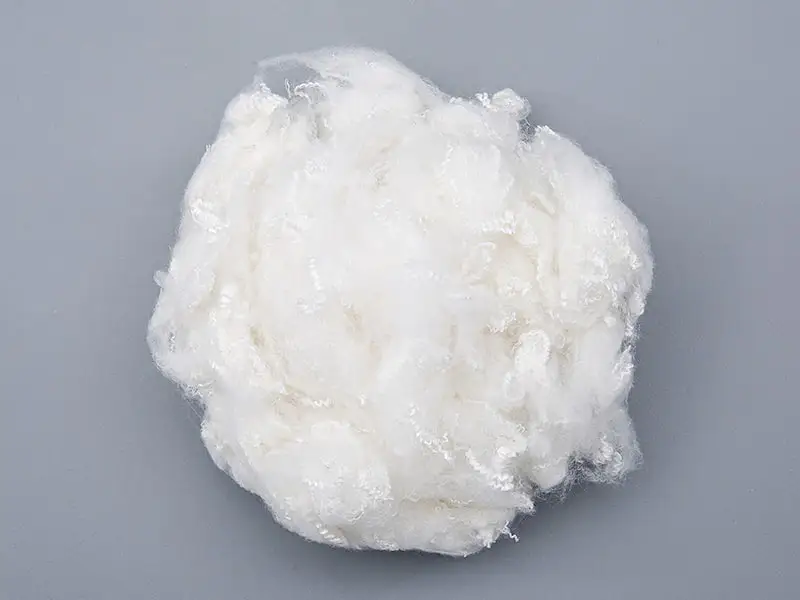
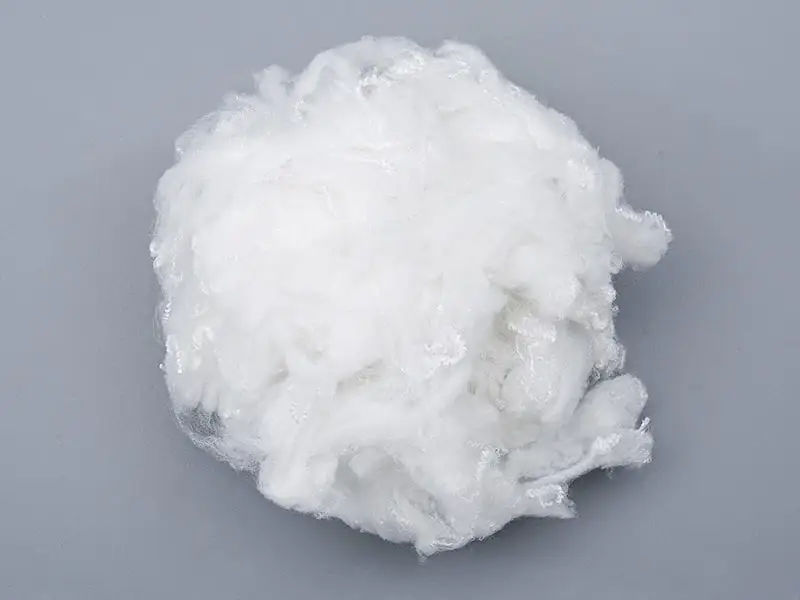
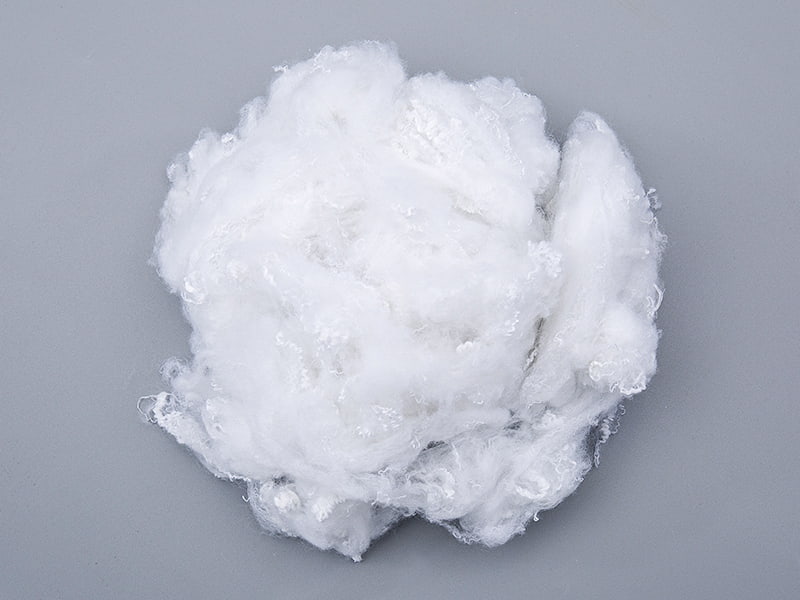
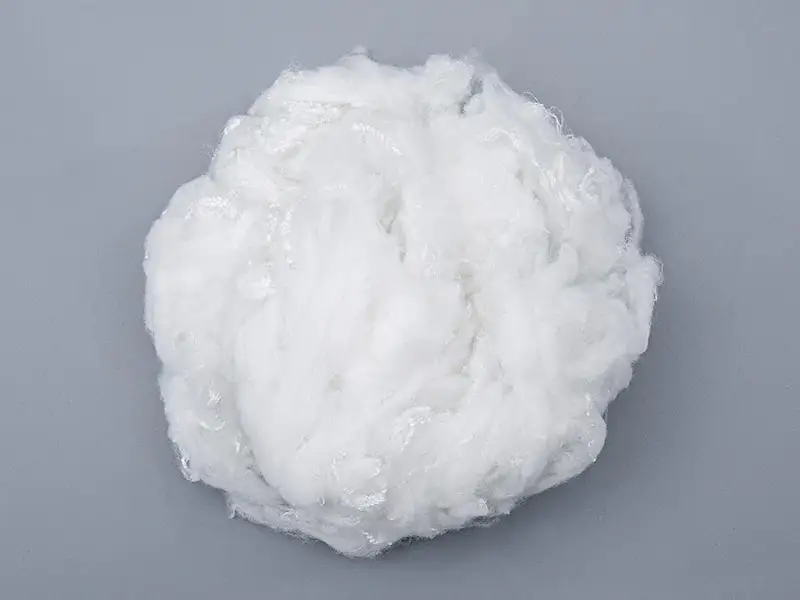
Engineers and sourcing teams who research polyester staple fiber are usually trying to solve a practical problem: how to get a yarn or nonwoven web that performs reliably at a predictable cost. Staple fiber is cut into defined lengths, opened, blended and spun or formed into a web, which gives producers control over blend ratios, yarn hairiness, bulk and handle. Continuous filament yarns offer smoothness, but staple fiber offers flexibility, and that flexibility explains why it has become a backbone material across knitted, woven and nonwoven lines.
Polyester is valued because it combines dimensional stability, good recovery, fast drying and a wide processing window. It can be blended with cotton, viscose, wool or other synthetics, and it runs well on modern ring, rotor and air-jet systems. The result is a material that appears in everything from everyday apparel to filling, hygiene and industrial wipes.
Production begins with a polymer melt that is extruded through a spinneret, cooled and drawn. Drawing aligns the polymer chains along the fiber axis, which raises strength and reduces elongation. Heat setting then locks the dimensions in place so the fiber does not shrink unpredictably during later processing. Crimp is introduced mechanically, and the continuous tow is finally cut to the target length.
Each step leaves a fingerprint on the finished fiber. Draw ratio influences tenacity, heat setting controls dimensional stability, and crimp frequency strongly affects how the fiber behaves in carding and how the resulting yarn feels.
Fineness is usually expressed as denier, the linear density of a single filament. Finer deniers produce softer and more drapey fabrics, while coarser deniers give stiffer structures with more bulk. Cut length and crimp must then be matched to the spinning system, because a fiber that suits a worsted-type line may cause problems on a short-staple ring frame.
| Cut length range | Typical spinning system | Typical end use |
|---|---|---|
| 32 to 51 mm | Short-staple ring spinning | Knitted and woven fabrics |
| 51 to 64 mm | Ring or rotor spinning | Cotton-polyester blended yarns |
| 64 to 76 mm | Wool-type or worsted systems | Suiting and worsted blends |
| Above 76 mm | Specialty and heavy-yarn lines | Carpet yarns and heavy structures |
These ranges are general guidance rather than fixed rules. Actual selection should be confirmed with trial runs on the specific machine, because roller settings, card clothing and humidity all shift the optimal window.
Round fibers have long served as the baseline, but shaped cross sections change how a fiber interacts with liquid and air. Grooves, lobes or hollow channels increase the surface area per unit weight and create capillary paths along the length of each filament. When these fibers are assembled into yarn and fabric, the channels between them become pathways for moving moisture away from the skin.
The moisture benefit comes from three effects that work together:
Performance depends heavily on construction. A tightly twisted, dense yarn can close the channels, so the advantage is most visible in single jersey knits and lightweight plain or twill weaves. Heavy fabrics with high cover factors may show a smaller difference, and finishing chemicals can either enhance or suppress wicking, which is why laboratory wicking tests on finished goods are more informative than fiber data alone.
Typical fineness span across staple grades
Common cut length range for spinning
Strength retained after moisture exposure
| Property | What it affects | What to check |
|---|---|---|
| Fineness (denier) | Softness, drape and fabric weight | Spec sheet and cross-check by sample measurement |
| Cut length | Spinnability and yarn evenness | Length distribution report |
| Crimp level | Bulk, cohesion and carding behavior | Crimp frequency per unit length |
| Tenacity | Yarn breakage and durability | Lab testing on each incoming lot |
| Dyeability | Color uniformity and shade range | Dye trial using the intended process |
| Moisture transport | Comfort and drying speed | Wicking test on finished fabric |
A common mistake is to compare fibers only by price per kilogram. Two lots with identical nominal denier can behave very differently if their length distribution or crimp consistency varies. Asking for distribution data and lot-to-lot variation ranges usually reveals more about processing risk than a single average value.
Fiber quality only translates into product quality if the process preserves it. The flow below shows a simplified sequence from polymer to cut staple, where each stage can introduce or remove variation.
Bale opening and blending should aim for uniform mixing before fibers reach the card. Fibers that are very fine or highly crimped tend to create neps and static charge if the room humidity drops too low. Many mills keep relative humidity in a moderate band and monitor it continuously, because electrostatic behavior can change noticeably within a single shift.
Drawing frames are where evenness is established or lost. Sliver irregularity at this stage tends to appear later as yarn count variation and thin places. Maintaining consistent roller settings and checking sliver weight at fixed intervals is far more effective than correcting problems at the winding stage.
Recycled polyester has moved from a niche option to a mainstream consideration for many spinners and converters. Buyers now ask not only about performance but also about feedstock origin, traceability and the environmental claims behind a product. The most useful way to evaluate recycled polyester fiber is to separate the real trade-offs from the marketing language.
For mills evaluating a new source, a pilot blend in the range of ten to twenty percent recycled content is a common starting point. It allows the team to observe processing behavior and shade consistency without committing the full line, and it generates the data needed for a sound decision.
Each end use places a different weight on fiber attributes, so the same material can be specified in very different ways. The table below summarizes how priorities shift from one application to another.
| Application | Priority attribute | Typical fiber approach |
|---|---|---|
| Knitted sportswear | Moisture transport and softness | Fine denier with shaped cross section |
| Woven shirting | Dimensional stability and smooth handle | Medium denier with low crimp |
| Socks and hosiery | Abrasion resistance and recovery | Blends with elastic yarn |
| Nonwoven wipes | Loft and bonding response | Consistent length with controlled crimp |
| Filling and insulation | Bulk recovery after compression | Crimped or hollow structures |
The practical implication is that specification should start from the finished product and its wear conditions rather than from a catalog description. A fiber that performs well in a lightweight knit may be unnecessary, or even counterproductive, in a heavy woven fabric where cover and stiffness matter more.
A structured approach reduces the risk of costly re-runs. The following sequence has proven useful for technical teams that need to move from concept to a reliable production specification.
Most of these problems share a common root: variation that was not measured. Establishing simple incoming checks and recording process data turns intermittent defects into manageable parameters.
Cut length determines how fibers overlap and bind in the yarn. Longer fibers generally produce stronger, smoother yarns, but they require machinery that can handle them. Shorter fibers give more cohesion in certain systems but can increase hairiness if twist is insufficient.
Performance can be comparable when the recycling process and sorting are well controlled, but differences in tenacity, color and consistency are possible. Equivalence testing on each new source is the most reliable way to confirm suitability.
A complete spec sheet should include denier, cut length and its distribution, crimp frequency, tenacity and elongation, dyeability information, and any relevant certifications or traceability records. Lot-level data is more valuable than a single nominal value.
Not automatically. The benefit depends on fabric construction, garment fit and the activity level of the wearer. In dense or heavy fabrics the difference may be small, so wicking should be verified on the finished product rather than assumed from fiber data.
Bales should be kept in a clean, dry environment with stable temperature and humidity. Prolonged exposure to moisture or direct sunlight can affect handling and color, so first-in, first-out rotation is a sensible practice for any inventory that is held for extended periods.
Emon Technology is willing to sincerely join hands with you, cooperate for win-win results, and create brilliance together!
Tel: +86-512-63679088
Email: [email protected]
[email protected]
[email protected]
[email protected]
[email protected]
Add:South of 318 National Highway, Miaotou Village, Meiyan, Wujiang, Jiangsu
Copyright © Suzhou Emon New Material Technology Co., Ltd. All rights reserved.



 English
 中文简体
 Español