2026.11.27
 Industry Information
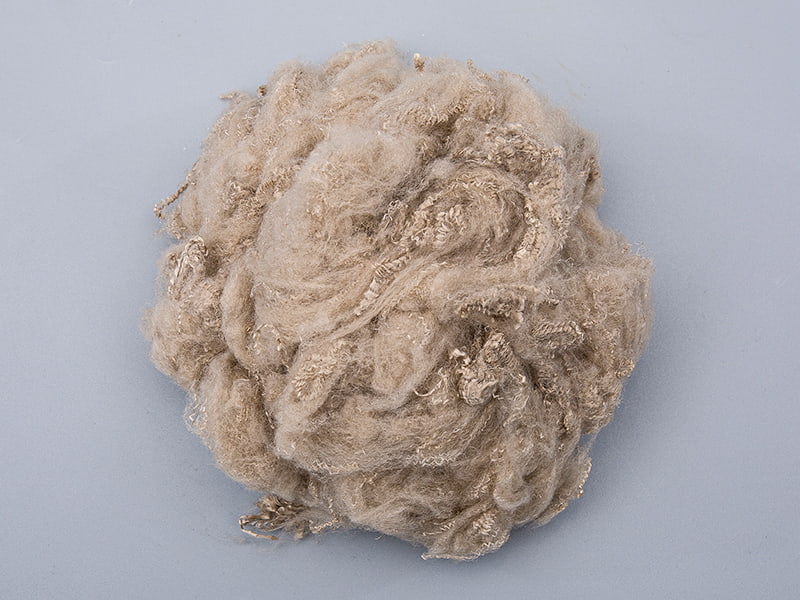
Modern recycled polyester fiber can match virgin material in spinnability, dyeability and mechanical strength when it is produced with tight process control. For mills and converters, the question is no longer whether recycled fiber works, but how to select the right grade, verify its consistency and turn it into a measurable cost advantage.
This guide breaks down what makes a textile raw material production-ready, compares recycled and virgin polyester on the metrics that matter to buyers, maps fiber types to specific applications and outlines how to evaluate a supplier beyond the price quote.
A plant manager rarely asks whether a fiber is strong on paper. The real question is whether it runs cleanly on the line shift after shift. Fiber consistency matters more than peak tenacity, because variation in length, fineness or crimp causes end breaks, uneven yarn and costly downtime.
| Spinning System | Fiber Length Tolerance | Consistency Priority |
|---|---|---|
| Ring spinning | Medium | High |
| Vortex spinning | Tight | Very High |
| Air-jet spinning | Tight | Very High |
Unit price alone does not tell the full story. The true comparison combines raw material cost, rework rate, dyeing yield and the commercial value of certified sustainable content.
| Criteria | Virgin Polyester | Recycled Polyester Fiber |
|---|---|---|
| Raw material price | Tied to crude oil volatility | Often more stable and competitive |
| Tensile performance | Benchmark level | Comparable with proper grading |
| Dyeability | Uniform | Uniform with strict batch control |
| Sustainability credentials | Limited | Supports GRS-based claims |
| Brand premium potential | Standard | Higher for sustainability-driven buyers |
Batch-to-batch consistency, not the headline strength figure, is what determines whether a recycled material truly saves money. Stable color and fiber performance eliminate rework, and that is where the cost advantage is realized.
For downstream garment and home textile producers, certified recycled content also supports orders from brands that require documented sustainable sourcing. Requirements such as GRS certification and recycled content traceability are increasingly written into purchasing contracts, turning a material choice into a sales advantage.
Teams looking to build this comparison into their own sourcing plans can also consider a textile raw material specification sheet to benchmark performance against current virgin supply.
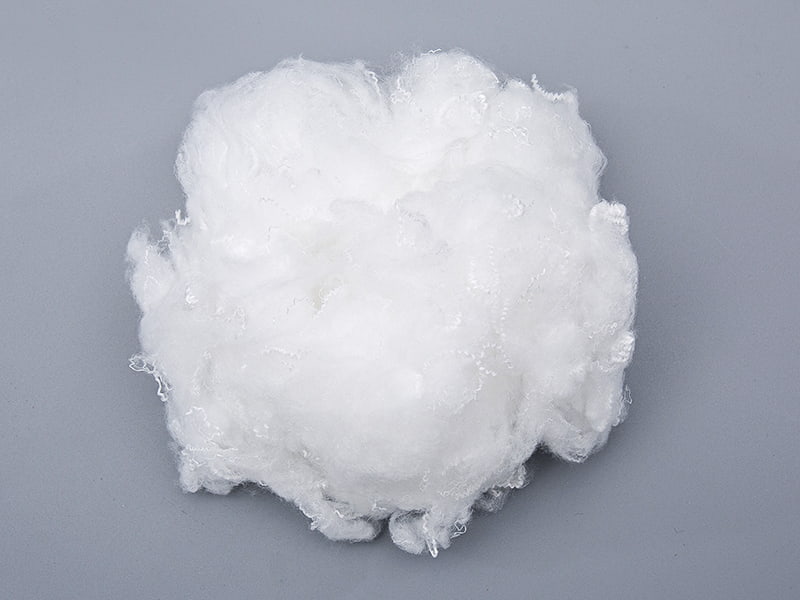
The right fiber structure depends on the finished product. Solid, hollow, 2D and 3D configurations each deliver different handling, bulk and resilience characteristics.
Look for fiber opening quality and thermal bonding stability. Uniform fiber dispersion produces consistent web weight and reliable bonding under heat.
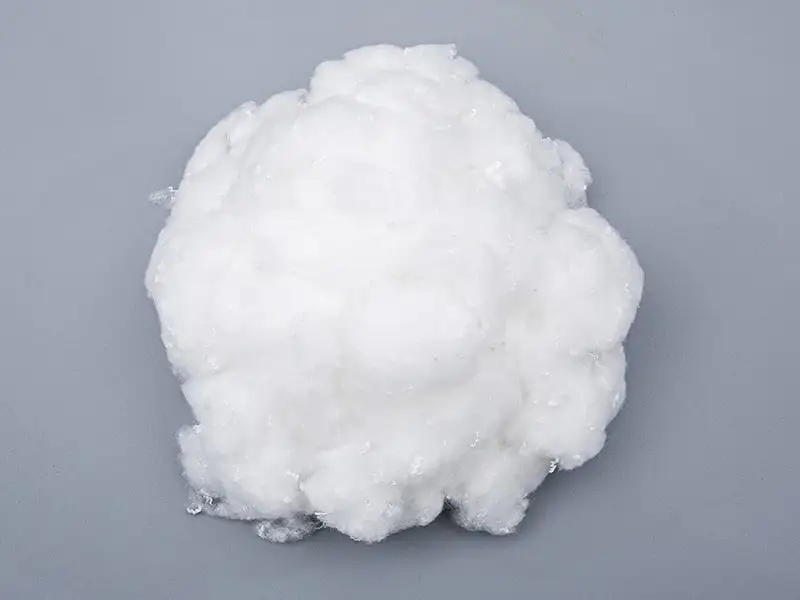
Three-dimensional hollow fiber is the usual choice. Its crimp and hollow structure deliver loft, springback and a soft hand that buyers judge immediately.
Prioritize fineness control and low contamination, which support consistent molding and reduce trim waste.
Experienced buyers evaluate suppliers on capacity, process control and third-party verification before they compare prices. A low quote from an unverified source often leads to hidden costs in rejected lots and delayed shipments.
Yes, when fiber length variation is tightly controlled. Request the technical data sheet, which lists length distribution and coefficient of variation, and confirm it against your line specifications. Contact us for a tailored evaluation.
Minimum quantities are negotiable for first trial orders, and free samples are available for evaluation. Contact us to discuss your requirements.
Production follows strict quality control with batch-level monitoring, which reduces dyeing rework for customers. Contact us for detailed quality documentation and a quote.
Send us your specification sheet, including fiber fineness, length and intended application, and our engineering team will reply with a tailored quote and sample plan within 24 hours.
Emon Technology is willing to sincerely join hands with you, cooperate for win-win results, and create brilliance together!
Tel: +86-512-63679088
Email: [email protected]
[email protected]
[email protected]
[email protected]
[email protected]
Add:South of 318 National Highway, Miaotou Village, Meiyan, Wujiang, Jiangsu
Copyright © Suzhou Emon New Material Technology Co., Ltd. All rights reserved.



 English
 中文简体
 Español